I ceased even irregular blogging for quite a while--I wasn't seeing much interaction, and much of what I was working on wasn't really appropriate for sharing. But I'm hoping to get back in the game, partly I suppose because one of my current projects is looking at Microsoft Teams, a quite advanced threaded-chat-and-more platform that has gotten my collaboration juices flowing again. More on that later.
My career has continued to evolve--I am now a Director at Goodwin, and also since September have been a co-chair of the incredible events that will be ILTACON 2018 (National Harbor, MD) and ILTACON 2019 (Orlando, FL).
On that last point, I wanted to share that the ILTACON website now provides a way (for the next few weeks, in any event), for potential speakers and moderators to apply. This is a new process for ILTACON, one of the joys of working with ILTA and this fantastic group of event professionals and peers is that they are not afraid to try new things!
The way it works is, a full list of sessions is available (the ILTACON committee has been working on developing a set of sessions since October). Potential speakers or moderators fill out the form, indicating the session where they are seeking to participate. Fill out a separate form for each session in which you are interested.
Thursday, April 19, 2018


Wednesday, September 28, 2016
Article in Legal IT Today Magazine

The focus of the article is on the value of visualization tools for leveraging matter experience information. While I can't show the Goodwin Litigation Intelligence tool, I describe its development and functionality, and the benefits to my clients the partners at Goodwin and their clients in turn.
Thursday, February 25, 2016
Business Intelligence and Analytics In the Legal Profession--Ark Group Conference April 28
 I'll be speaking again at an Ark Conference, this time, at the fourth "Business Intelligence and Analytics in the Legal Profession" conference, to be held April 28th at the AMA Executive Conference Center in New York.
Formal title: Business Intelligence & Data Visualization Use-Cases
Description:
Legal organizations are awash in rich information about the work they do.In many ways this presentation will be a follow-on from the presentation at ILTACON 2015 on "Best of Business Intelligence: Stories of Success" (recording available.) We've made progress in identifying some important use-cases and in leveraging our matters data since then, of course.
Lawyers record time in six-minute increments, save dozens of documents a day,
and even assign each client and matter a unique number, (a system much envied
by our corporate knowledge management peers). Yet few legal organizations
take full advantage of the data that they have, despite the increasing prevalence of
advanced data analytics and visualization tools that make access and interaction
with the data much easier and faster. This case study will share one law firm’s
story about visualizing matter data, starting with a sophisticated
matters information system and moving on to show an interactive business
intelligence system focused on what lawyers need to know about their matters.
Uses include business development, competitive intelligence, knowledge
management, and pricing and budget analysis.
Hope to see you there!
Friday, August 28, 2015
ILTA Conference 2015

I've been neglecting this blog to some extent in favor of some other channels lately, and also in favor of some other activities.
This year I've been the Team Coordinator for the Information Management "track" at the International Legal Technology Association's annual conference "ILTACON," which starts on Sunday. The eight members of my team have developed a great slate of 32 sessions addressing knowledge management, information governance, data analytics, social media, innovation in legal services delivery, and related topics.
On the ILTA blog platform, which is somewhat public, I've posted "Find Your Way to the Education You Want" (about how to plan for ILTACON and how to search through conference sessions), and "Knowledge Management Sessions @ILTACON" that has a detailed description of a possible set of sessions of interest to knowledge managers.
I'm also hosting the #tweetup, which is a Community of Interest, Sunday at 4 PM in Genoa. This year it's hosted by ILTA, and there will be discussion of tweets, tweeps, and tweeting, other social networking, social media sessions, and maybe a little viola playing so we'll have something to tweet about.
Later in the week, if you want to hear me talk about a subject I've been working on a great deal this year, come to Roman 1 Wednesday at 11 AM for "The Best of Business Intelligence: Stories of Success", Session #100. I'll be discussing recent experience with the use of visualizations and business intelligence for practice improvement, matter analytics, and business development.
Lastly, if any readers are at ILTA member organizations and have attended at least one ILTA conference, I hope you'll consider applying for conference committee. I promise that you will learn a lot, meet great colleagues you otherwise would never encounter, and have a great experience.
Monday, April 27, 2015
The Iron Tech Lawyer Competition, 2015 Edition
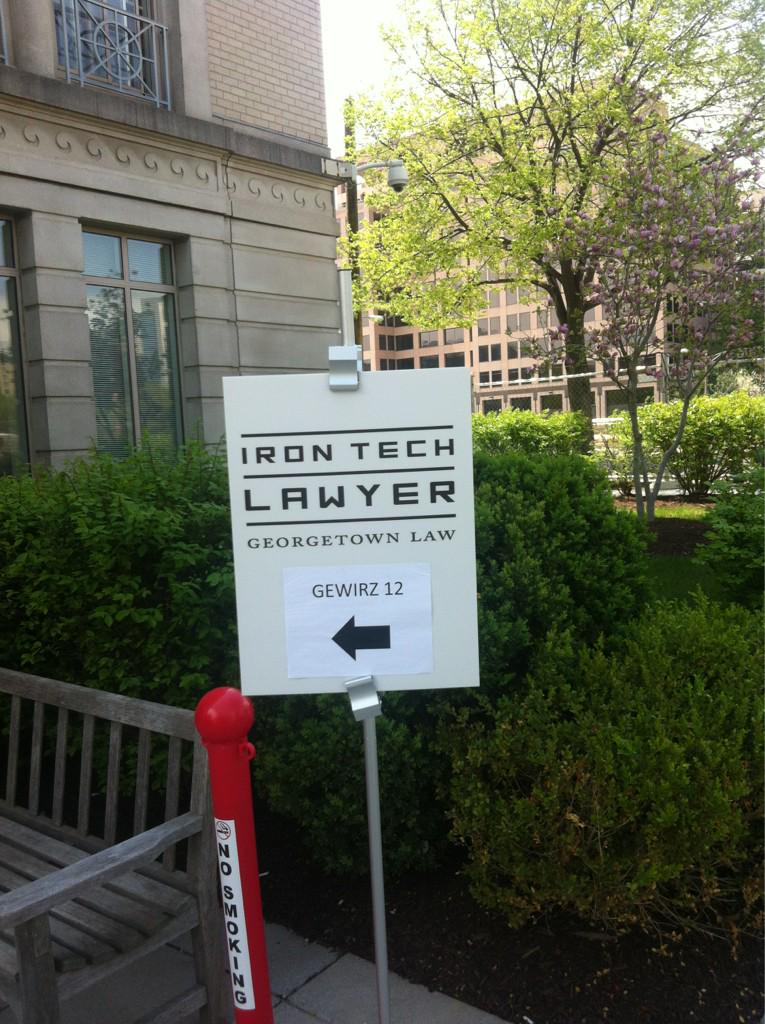
This post addresses the competition: a later post addresses the conference. For pics and other's comments you can follow the hashtag #irontechlawyer and follow @GtownLawIronTech.
I have previously covered the Iron Tech Lawyer competition; in essence, it is an app development contest targeting a legal services-type challenge. What’s great about it is that the students get to address client problems by combining their legal reasoning and analysis with advanced technology. The technology (provided by Neota Logic) is sophisticated enough to be able to embed a big chunk of their legal understanding, but simple enough to develop and use that they can provide a web-based app that actually could be useful.
I was intrigued this year by the different strengths and approaches shown by the six teams (of three or four students each). Some teams did a great job at identifying a clear user need that could be met by an app, or had carefully teased out a coherent use-case for their solution; some had thought carefully about what sort of design would be a good fit with what their users needed, or perhaps designed their app while thinking about and preparing for its further development; and some had developed a strong, coherent presentation or showed strong presentation skills. The subject matter ranged from Native Alaskan tribal child protection issues to federal disability rights to California elder law.
All
of them were able to get remarkably far in the 10 weeks or so that they had to
develop the app; if it is any consolation to them, they should know that any
kind of significant, enterprise IT project takes significantly longer than the
time they had in class.
The judges evaluated and questioned the students about how
they teased out the user / client needs, or identified the client population;
how they learned about the underlying law and built it into their applications;
and also the type of output or result that could be obtained.
Details on the six apps, also described here, follow.
ADA2GO
The first team’s Americans with Disabilities Act app
focuses on Title III, relating to accommodation of individuals with
disabilities in the provision of public facilities. Examples include restaurants, hotels, salons,
and bowling alleys.
It is targeted at both individuals not aware of their rights and
businesses not aware of their obligations. They tried to focus on the needs of
their disabled users, making sure for instance that the app would work with
screen-readers.
They started with a potentially discriminatory situation
rather than a venue. Tried to provide context-specific examples. Hover-overs
provide definitions and examples. The
app also connects to the correct Department of Justice area. After answering a
series of questions, the users are provided a final report, which can be in
.pdf form. It provides a description of the users’ rights and responsibilities.
The app’s decision tree leads to different sets of .pdf reports.
They worked with the Department of Justice division that
supports the ADA. They heard that the
disabled user community would not necessarily have sophisticated technology,
and would also might need to use screen readers. They tried to make the app
simple and easy to use.
I really value the team's attempt to make the app about disability rights particularly accessible. I think they may have bitten off more than they could chew by addressing needs of individuals (potential claimants) AND businesses (potential defendants). This app has very broad potential applicationn.
Alaskan Native Child Welfare Assistance
The app addresses the extensive removal of Alaskan Native
children from their families, with frequent placement away from Native Alaskan
families.The focus of the app was on the tribal representative needs rather than the individuals opposing removal in a particular case.
The challenge is that most tribes can’t afford a lawyer. Many of them are located thousands of miles
away from their tribe. Yet the tribe has the right to intervene in state court child
removal cases,
and has a right to a guardian ad litem who knows about a specific Native Alaskan tribe. The app provides information about particular removal
situations and also yes/no answers about tribal and individuals rights, for
instance, that the tribe can participate telephonically in removal hearing even
if the representative can’t be there in person.
This app had a very interesting targeted focus and use-case; I have some experience with child protective work, and appreciate the attempt to provide more information to tribes, who have needs that apparently are not being properly addressed, leading to injustice and loss of tribal integrity. The outcome of the app seemed to continue to contain a a fair amount of legal jargon, however, making the resulting information perhaps hard to digest.
California Legal Aid / Elder Law
The challenge is the LawHelpCA.org web site, which has a
ton of information, is not easy for users who may not understand legal
terminology (such as “capacity.”).
They use four different approaches to showing information. The app contains plain language descriptions of aspects of
California elder law. It provides pieces of information to the
users depending on their answers about their situations.
The team saw their app as a "proof of concept", and clearly spelled out how the app could be further developed and
expanded.
A user could (in the future) indicate if she was simply
interested in learning more about, for instance, in-home care, or could
indicate that they need specific questions. I especially appreciated this team's focus on what it could effectively accomplish within the time and resource limits that they had, and the way they structured the work they did with an eye towards potential expansion. That's often the way apps like these might get started in the "real world" (see Minimum Viable Product).
Disaster Assistance & Recovery Tool (DART)
This app addresses needs of hurricane and flood survivors to access
the many different resources and help that can help them. A secondary user is Lone Star Legal Aid. Their goal was to simplify legalese, keeping the language to a sixth-grade level, and also have it available either in a mobile form or via PC browser.
The app helps find disaster assistance resources and apply
for loans.
They wanted to make the app user friendly, provide
guidance, tell users how to avoid pitfalls, and educate them. User-friendly to them meant very few questions on a page,
with a yes-no question response leading to an additional question on the same
page. They leveraged an expert’s knowledge of what people commonly get wrong to provide tips and links to forms along with deadline warnings. Answers led to a list of types of eligibility, along with a set of next steps, application forms, and a .pdf download.
The app contains four separate decision trees for eligibility determinations. They hope it can be expanded beyond hurricane and flood disasters, and also to other states.
This was the winning app, according to the judges. I concur that DART did a great job focusing on a needy population and delivering targeted, well-designed help.
Transnational Anti-corruption Advisor
This app represents the first attempt in Iron Tech Lawyer to work with foreign law
or with an international law firm.
A4ID “Advocates for International Development: Lawyers Eradicating Poverty” was their
partner / client.
The app allows users to assess whether they have or are
about to violate the US Foreign Corrupt Practices Act or the UK counterpart the
United Kingdom Bribert Act of 2010. They had to blend two sets of laws, and
faced users who may not be familiar with the US or UK legal systems. Cultural
expectations might differ also between US/UK and international users.
They wanted to make the app simple to use, and easy to
extend. They used short subheadings, and integrated definitions of key terms.
They broke down the law into 9 small decision trees.
Veterans Benefits Disability Advisor
The team was shocked to find that there are 3.5 million
disabled veterans in the US, constituting over 15% of all veterans. They worked with the Bob Parsons Veterans
Advocacy Clinic.
Veteran’s benefits law is a very tangled web. Many
veterans could have been better served in going through the benefits
acquisition process if they worked with a veteran’s services organization.
The application helps with several specific processes,
such as obtaining medical records or determining discharge status. Being there was better than observing on the web, particularly in giving a better perspective on the presentation skills of the different teams. The Iron Tech Lawyer competition and class continues to give law students a great perspective and actual experience on what it is like to apply legal technology to solve real-world problems.
Wednesday, March 4, 2015
Book Review of Eric Hunter's "The Sherlock Syndrome: Strategic Success through Big Data and the Darwinian Disruption"
 Eric Hunter is a legal knowledge management colleague and recipient of ILTA’s 2010 Knowledge Management Champion Distinguished Peer and Innovative Member awards. He is Director of Knowledge, Innovation and Technology Strategies at Bradford & Barthel, LLP (a California law firm focused on worker’s compensation) and also Executive Director of the Spherical Models consultancy.
His wide-ranging report puts business analytics and the insights it offers at the core of wide-ranging potential changes in legal and other industries. Though future-oriented, it spends most of its time on developments whose beginnings are firmly entrenched, such as video search, wearable tech, big data, and data visualization.
Through my own work I have come to believe that legal organizations – and perhaps organizations in general – can obtain significant competitive advantage by leveraging analytics and technologies and taking better advantage of our increasing connectivity and ability to share inside and outside the organization. Hunter’s report provides more substantiation for those beliefs, and also projects ahead to suggest how to prepare for the increasingly rapid changes that are coming. I appreciate that Hunter is “walking the walk,” talking about increased sharing while doing so himself through this book and his many presentations at Ark and ILTA conferences (referenced throughout the report).
Sherlock Syndrome
The title’s “Sherlock Syndrome” concerns our increasing ability to observe, sense, cross-reference, and analyze information and trends much more comprehensively than before through data analytics and Big Data. The trend is one of massive increases in the ability to recall, analyze, and leverage information. Hunter posits that, at least with respect to personal preferences and search patterns, “everything is becoming predictable (and therefore marketable) through analytics.” Particularly striking to me is the thought that not only are the abundance of data and power of our computers increasing rapidly, but also the sophistication and availability of easy to use analytics tools are making this information actionable in ways that were never before possible.
I have seen this myself in my firm’s exploration of the Tableau data visualization tool. Business use-cases for Sherlockian advanced perceptions include forensic (criminal) investigations, insurance claim investigations, and, of course, targeted consumer advertising.
Darwinian Disruption
Hunter also believes that “Darwinian data disruption” is affecting the entire business world. It is not simply data—though the scope of data is increasing dramatically every year—but also computational and analytical capacity that is growing so dramatically. Hunter’s disruption is Darwinian because leveraging these changes provides a clear competitive advantage and those organizations and business leaders able to adapt to the new environment will survive. Businesses that cannot adapt to and take advantage of these technologies and changes may not survive. It may have been said many times before, but it is true: as Hunter observes with many examples, we are seeing accelerating levels of market disruptions as companies learn to innovate faster.
The (Edward) Snowden Effect
Hunter spends a good deal of time digging into the “Snowden” effect (not David Snowden the KM guru, but Edward Snowden, the former NSA contractor). In Hunter’s view, Snowden’s revelations of widespread government capture of vast amounts of personal information in pursuit of national security encapsulate the inevitable tension among privacy, the right to share, and the (security and other) benefits of access to others’ information. Snowden demonstrated that cross-border information sharing is happening and will happen more and more. The NSA, US government agencies, and other governments that capture and share personal information are in his view just taking to an extreme and for different ends what corporations like Facebook and Google already do to target advertising to consumers.
The Predictive Orchestra
A skilled jazz and classical bass player, Hunter hits my sweet spot with an extended metaphor of a “predictive organization” as symphony orchestra, all playing from the same music and not simply following a leader, but also anticipating the melodies and entrances of other sections. (I would promote leaderless orchestras like New York’s Orpheus chamber ensemble http://www.orpheusnyc.com/ as a better fit for his progressive view than the hidebound, intensely hierarchical traditional symphony orchestra. For instance, in a traditional orchestra, the musicians within a section are positioned on the stage by rank according to purported ability!)
Legal Industry Impacts
Hunter does not neglect the implications of these much broader developments for the legal industry. Within law firms, Sherlockian advanced perceptions aid pricing, methods for doing legal work, internal communications, and understanding and addressing client needs. The new technology, analytics, and cross-border flow of information have the potential to greatly enhance law firms’ understanding of their clients and clients’ understanding of legal issues. The technologies increase the capacity for clients and firms to build “targeted relationships” and provide a continually expanding set of opportunities. And, the same data collection and predictive analytics that Facebook and Bing use to identify our consumer interests also identify our business needs. Analytics technologies can be applied directly to some types of legal issues, such as the likely extent of exposure from a given worker’s compensation claim.
Another example is law firms’ new ability to bring transparency to matter work, including data analytics around pricing and profitability, staffing models, and project models. Hunter spells out how the concept of “velocity billing” combines client-specific account managers, predictive analytics driving client- and firm-appropriate fee arrangements, and social collaboration around matter and client work has affected his firm. In combination, these processes and technologies lead to very efficient and client-targeted legal work.
Another instance of these technologies manifesting in law firms is his own firm’s adoption of Google Plus (“G+”). While much-maligned as the place where only Google employees “hang out,” Hunter sees G+ as a great example of a system that is both inward- and outward-facing and combines search with a designed social platform. Creating a G+ circle is the kind of fluid, effective, searcheable content and process management Hunter sees in the future of legal work. For Hunter’s firm, G+ is both an internal- and partially external-facing social network and platform. He notes that social network implementation and internal change management, like the pricing and client management projects he has had so much success with, involve different change management dynamics needing different approaches.
For law firms and the general corporate world, the technologies, techniques, analyses, and insights gained and shared so rapidly can be applied to not just readily quantifiable attributes of work such as hours, effort, and outcomes, but also leadership and change management at the levels of self, team, and organization as a whole. Hunter’s exhortations on leadership are very similar to what you might hear from many an Eastern-philosophy or martial arts- influenced business leadership book; what differs is the tie-in to his Sherlock/Darwin analysis.
Hunter suggests that people, teams, and organizations should be reinventing themselves through these enhanced perceptions and abilities every 18 months.
Complaints, Conclusions, and Inspirations
One concept that could have been more clearly elucidated is Hunter’s “spherical analysis/spherical modeling.” Google search suggests that these terms are not widely used in the business intelligence or data analytics communities—references to spherical analysis or models typically relate to variogram models that address how distance effects correlation between variables or a method of modeling magnetic forces (see the spherical models Wikipedia article.)
Much of the report is fairly abstract; I would not go to this book for an introduction to business analytics or Big Data. Nor was it entirely easy to read, with a fair amount of repetition and some extraneous quotes from Ghandi, Leonardo Da Vinci, and Hunter’s martial arts instructor. Finally, the size of the book’s print is too small (at no more than 10-point font) and somewhat faint. Perhaps the book is easier to read on-line (admittedly an appropriate production strategy given the book’s topic).
Overall, I found Hunter’s report an intriguing and inspiring application of broad industry, technology, analytics, and behavior trends to the ground level of the key interactions between law firms, legal work, and clients. His predictions about predictive analytics and more are in some cases not predictions at all; he shows how these can play out and have an impact on a legal practice area. They should not be ignored. I would not be at all surprised if many of his other predictions are soon borne out more broadly in our industry.
Saturday, August 16, 2014
Blogging at ILTA?
 Normally the International Legal Technology Association (ILTA) annual conference is where I blog the most each year. Excellent, timely, substantive discussions or presentations, that I can report on without having to create--what's not to like?
This year is a little different. I am on the "Conference Committee," the group of ILTA peers that organizes the educational sessions, as the representative from the ILTA KM Peer Group. We have responsibility for the "KM track," six of the sessions here that relate to knowledge management. Late in July I authored a post on the ILTA KM Blog that offers a preview of the excellent sessions that we'll be presenting. I encourage readers to attend or follow remotely (hashtages start with #kmpg1 and go to #kmpg6); but, needless to say, I'm going to be a little too busy to blog, at least for those six sessions.
If you read this blog, and you attend one of those sessions, or otherwise see me at conference, please come say hi--I'll be there!
Saturday, June 28, 2014
Law Department Knowledge Management News, Webinar, and Development
As suggested by reports from a recent
roundtable moderated by Joshua Fireman and Ron Friedmann, law firm
knowledge management, while not booming, is certainly increasing in its
penetration among large firms, and continues to succeed in a variety of ways.
A few recent developments have led me to believe that a
similar rise in legal knowledge management activity and interest is occurring
in law departments (general counsel’s offices).
First, my firm’s knowledge management group was recently asked
to (and did) present on our KM journey, and our thoughts on how to get started,
to a few Massachusetts law departments.
Second, Linklaters
released their nicely-packaged “Knowledge
to Action” report, focusing on the value of knowledge management to general
counsel (though it disparages the term “knowledge management” and the term “general
counsel,” preferring “legal knowledge” and “legal risk officer.”).
Third, along with Robert Bell,
Assistant General Counsel & Legal Knowledge Officer at RBC Law Group (Royal
Bank of Canada), I have been asked to speak on Legal Department Knowledge
Management by C4CM, also known as the “Center for Competitive Management.” (This webinar has been cancelled, however, but may run in the fall).
I have already been thinking some about the differences
between legal knowledge management as practiced in law firms and in law
departments (within corporations), and the conditions for the same. Law departments have typically not invested significantly
in knowledge management, compared to law firms, and have less advanced
legal-related information access and delivery.
In part, this may be due to the traditionally smaller numbers of lawyers
found in large corporations, compared to their outside counsel.
Law departments may also be different from law firms in the
following ways, which impact the ability to initiate and sustain legal
knowledge management efforts:
- General
counsel have limited or no billable hour pressure; rather, they need to be
responsive to the direct demands from the corporation and its employees,
ideally as efficiently and broadly as possible.
- General
counsel work for a single company, usually in one industry; they are often
located in offices associated with different lines of business within a
company, and as a result may be far more geographically separated from
other attorneys than a law firm of comparable size. They likely have fewer information needs
around getting to know their industry—they deal with their company all
day, every day—and more around connecting with and learning from other
attorneys.
- General
counsel’s office are only one (non-revenue-generating) part of a
corporation; the general perception is that general counsel find it more
difficult to obtain IT resources and attention than is the case in law
firms, since the organization as a whole is not focused on legal work.
- While
legal-specific technology investment may be limited, law departments may
have access to corporate technology—particularly sophisticated enterprise
social network and financial analytics software—not broadly available in
law firms. There may also be
line-of-business knowledge management staff and processes that can be
readily leveraged for the law department.
Monday, April 28, 2014
Iron Tech Lawyer Spring 2014--Legal Technology That Works

I viewed most of the live streaming Georgetown Iron Tech Lawyer competition Wednesday afternoon (April 23rd).
Previous related coverage of Iron Tech Lawyer includes Scott Rechschaffen's thorough post on the ILTA KM blog about his experience as an Iron Tech Lawyer judge last spring and my December 2013 post about Michael Mills' visit to speak at the Boston Innovation meetup (for background on the underlying legal technology, Neota Logic, which graciously provided free software and support).
I really liked how the law students worked. Each team tried hard to identify the specific client needs that could best be met by a specific application of Neota Logic's technology, recognized challenges that clients, and the clients' clients, faced, and proposed solutions that kept the apps simple and usable.
Answers Or Coaching?
Normally I think of expert system applications as resulting in partial or complete legal answers. As with Littler's HCR Advisor, a company or individual answers a series of questions, the system (very quickly) carries out an analysis, and, Hey Presto, you or your client is advised to [pay a $10 million Obamacare penalty] [pay no taxes for the next three years] [report the water quality violation to the EPA].
One of the applications, the Unemployment Benefits Hearing Coach, did not directly attempt to provide an answer, but rather, sought to in effect train individuals and companies about the unemployment benefits process and educate them about what may be the most important aspect of the hearing process, their respective burdens of proof, so they could be more knowledgeable about what they needed to do at the hearing.
In a former life (or so it seems now) at another firm I actually spent a frustrating few weeks representing an employer in exactly those types of hearings. It turns out to be suprisingly challenging to prevail as an employer--typically employers have the burden of proof to establish that you fired the employee for cause, with a valid rule that is consistently applied. For what it's worth, I checked out the wizard in the factual situations I was familiar with, and it matched my recollection of the appropriate standards.
What struck me is that these types of "training" apps could well be leveraged in a range of other situations. Even sophisticated firms could use an app like this one to provide basic information to a witness for deposition or trial testimony, in advance of meeting with the person, for instance. Or if a firm does a significant amount of a certain type of work, it could develop training apps for its associates or other junior lawyers, say around inter-state federal subpoenas or preparing deposition notices and logistics.
Apps As Workflow
Some of the apps were anonymous; others resulted in a report being sent on to the non-profit that sponsored the app, in effect operating as a partial onboarding tool. In fact, one of the apps, the Triage and Intake Assessment System, functioned in part as an onboarding tool, for the Virginia Legal Aid Society, It asked a simple series of questions that established the key facts (such as residence, income, and disability/age) that the VLAS needs to determine whether the user falls into the unfortunately comparatively limited pool of people who are its potential clients (compared to the demand for legal aid services). I think apps like these could serve as the start of an onboarding process for a law firm's pro bono or regular clients (as could traditional document assembly packages).
I do not envy the judges. One of the entries that had the lowest vote in the straw poll was the New York Sick Time Advisor , where the team was dealing with as complex and challenging set of rules faced by any of the teams, but with what at least appears on first glance to be quite dry and limited. How would you rate a team that tackled a challenging issue, and handled it well, but simply didn't have a subject that compelled interest or had widespread impact?
Conclusion
As I tweeted during the session, I found the whole set of presentations quite inspiring. These students students were using sophisticated technology to solve real-world legal service problems, using web-based, mobile-enabled applications that appeared simple to the user but can handle a high degree of sophisticated legal logic under the hood. They were able to pull these apps together quickly, without a rich understanding of the legal landscape, but with the ingenue's lack of apprehension and what is likely now a higher order of appreciation for the possibilities of legal technology than is the case with the broad run of lawyers.
For more on the competition, you can view the #irontechlawyer twitter stream, follow Georgetown Iron Tech on Twitter, and visit the formal site for the Spring 2014 competition.
**********
Update May 1, 2014--As recently announced on the official Awards page, the winners were:
- Iron Tech Lawyer--Unemployment Benefits Hearing Coach by Zachary Hutchinson, Stephany Fan, and Antonella Montagna
- Best Design-- Pennsylvania Children's Medicaid Appeals Advisor by Robert Brecht, Patricia Kim, and Erica Weinberger
- Honorable Mention--Triage and Intake Assessment System by Ari Atkinson, Michael Milea, Meredith Madnick, and Mauhan Zonoozy
- Social Media Award a/k/a straw poll winner--The Den: New York City Debt and Eviction Navigator by Matthew Smallcomb, Nicole Smith, and Kelly Wade
Thursday, December 12, 2013
Neota Logic Founder Michael Mills To Meet With Boston Legal Innovators

I'll be introducing Neota Logic founder Michael Mills at the upcoming Boston Legal Innovation meetup, next Monday night December 16th at 6 PM at the District Hall, 75 North Street (in Boston's Seaport District, near the Institute for Contempary Art and the Federal Court House).
Here's the formal session description:
"Neota Logic is one of most interesting and important companies working in legal technology today. In recent months, it has powered the Iron Tech Lawyer Competition, partnered with Seyfarth Shaw and Littler Mendelson, and helped a NY non-profit streamline its small business assistance program.
But what exactly does Neota Logic do, how does its technology work, and what does it all mean for the future of lawyers, law firms and legal departments? Find out on Dec. 16th by joining us at Boston's new innovation center District Hall for a fascinating conversation with Michael Mills, Neota Logic's CEO."
I've known Michael for a number of years from a knowledge management peer group we both participate in, and also from various ILTA events. Most recently in August he was part of an outstanding panel at the ILTA conference on online legal services; in 2012 he spoke on "The Lawyer's Role is Changing"; and back in 2010 we were on a panel together addressing knowledge management and alternative fee arrangements. But what exactly does Neota Logic do, how does its technology work, and what does it all mean for the future of lawyers, law firms and legal departments? Find out on Dec. 16th by joining us at Boston's new innovation center District Hall for a fascinating conversation with Michael Mills, Neota Logic's CEO."
I've always found him one of the most clear-headed, thoughtful, and witty members of the legal knowledge management community. I especially admire what he's done in identifying and then developing not simply a system to answer or provide greater insight into a particular set of complex legal questions, but a platform for developing such systems.
These systems work in similar fashion to document assembly or other "wizards" that walk the user through a series of factual questions, and then apply predetermined legal logic to produce a document draft. I've seen similar systems that could operate to generate a budget for a legal matter.
Expert systems such as Neota Logic have a similar front end; the end result varies but could be as simple as an answer like "No, you don't have to worry about X regulation" or as complex as "here's a map showing you the states where you have to worry about that wage law issue." They require a whole new model of development and of legal work, asking lawyers to think not just about a particular factual situation, but all the possible factual situations relating to a particular legal question, and then requiring them to identify what chain of factual questions are required for the system to be able to provide a useful answer. I've previously called this "dendritic logic," meaning that user's earlier answers influence which branch of additional questions they may have to answer.
As with most cutting-edge technology, scalability is a key advantage ; once the heavy investment of thought and research has been distilled into a Neota Logic solution, it can be leveraged by thousands or even millions of users, for very little if any additional cost for each additional user.
Probably the quickest way to gain an understanding of his company's work is to review the last two Iron Tech Lawyer competitions, for which Neota Logic has donated the software and services. On the ILTA KM blog, Scott Rechstchaffen describes the spring 2013 competition and results, which focused on legal services challenges (also covered by the ABA), and Neota's own blog described the fall 2013 competition, which focused on administrative law. See also Probono.net's Michael Mills interview.
I hope you can join us next Monday.
Sunday, November 10, 2013
Two Partner's Perspectives On Legal KM--Speeding and Improving Client Service
I recently attended a meeting of knowledge management practitioners from law firms. We had two law firm partner guests, who effectively spoke as the voice of the internal "KM client," albeit from a firm with a sophisticated and established KM program. I especially valued their thoughts because there was one transactional attorney and one trial lawyer. In accordance with the expectations under which they spoke frankly to us, I do not identify them or their firm. Any comments of mine are in brackets.
KM's Impact On Attorney Work
The transactional partner said that KM drives efficiency in his group. It helps to mitigate demand and improve client service in his matters. Generating work product quickly is of prime importance in his group's practice. People will always use a personal connection and network to learn how to do things and to get answers. KM can underpin that. When people contribute consistently to KM it can really take off.
The litigation partner said that being able to leverage prior work product is a prerequisite to being able to do his work. He can tell an associate is leveraging KM when they are able find things more quickly and better. He can also infer that an associate is probably not leveraging KM when an assignment comes back incomplete and not on time.
Speed of turnaround of answers is much faster between people who use KM systems and those who don't. It's about speed and delivery of service.
The US experience with a "heavy IT footprint" is not as advanced as that of Magic Circle firms.
Partners involved in KM need to continually remind senior leadership of the benefits of KM.
KM Advances Client Service For Transactional And Litigation Practices
Clients expect that you have good systems for leveraging previous firm work. If you are continually inventing the wheel you will appear more expensive and less effective than your peers.
Big financial services institutions expect law firms to be on top of their own business. The speed and depth and ubiquity with which you can marshal your firm's knowledge for your clients can be a competitive advantage.
In litigation, how to keep clients informed about the progress or status on a matter without distracting the matter team may be a key area for KM. The litigation partner has had great success with a client extranet, in particular with very large complex cases where the client needs to be aware of the case status on a daily or weekly basis. More effective information sharing with clients on litigation matters is a real opportunity, especially in firms that have invested in effective internal information management.
On the litigation side, some work product junior attorneys produce looks menial or routine. But there are usually case-specific nuances that require an attorney's eye, so document automation may be less useful. [I believe that document automation in more sophisticated practices is not necessarily designed to produce a final draft, however, so perhaps there is a role for document automation where there is a lot of consistency between work product types, for instance, in discovery "boilerplate."]
KM Improves Marketing and Recruiting
Reliance on previous experience in a pitch (appropriately) leads to client expectation that that experience can be leveraged quickly. Experience and leveraging that experience pertains to substantive legal knowledge as well the business and industry context of the client and its problems.
Sharing relevant precedent documents can also be part of a marketing strategy. [I saw this at the International Bar Association as well--internationally, law firms are sharing "scrubbed" precedents with clients as a way to add value and attract the clients to their expertise].
KM can attract talent by creating a good environment to work and not waste time. Recruits take technology into consideration, and ask about it in interviews.
Fixed Fees and KM
The nature of how you value legal services has changed. Alternative Fee Arrangements are highly relevant to KM. Fixed fees can be put into place for a whole year or for a particular piece of work around a particular motion. That kind of arrangement puts a huge importance in investing up front in what could make you more efficient.
Fixed fee work will continue increasing. The fee pressure is unparalleled.
KM Staff Expansion?
The Practice Support Lawyer ("PSL") role in the US is new but is gaining momentum. PSL and client development will merge as methods of developing business. PSLs can greatly assist a partner's focus on business development and billable work, because almost everything a PSL does in the way of client alerts, precedent development, and training, a partner would have done before.
Video training has helped people manage their time without losing content. But there is a certain human element that we can't replace yet.
Wednesday, October 9, 2013
Knowledge Management Panel at the International Bar Association

I spoke about knowledge management technology, specifically, what makes a piece of technology effective for KM purposes.
I concluded that effective KM technology:
- Connects people, content, and firm processes;
- Is easy to use for attorneys;
- Signals or provides access to information about content's trustworthiness;
- Does not normally require massive investments of attorney time outside their normal work; and
- Is consistently leveraged at the right time during the course of work.
Since the session is broken up into two separate panels, and I am speaking on the second panel, I am taking notes on the first session. I found it to be a strong session providing an excellent overview of justifications for knowledge management in legal and other professional organizations.
Speakers
- Aku Sorrainen, the organizer and chair of the session, is the founder of an Estonian law firm, a lawyer advising corporations in the areas of mergers & acquisitions and real estate.
- Shelley Dunstone is a consultant from Australia, moderating the first panel.
- Gerard Tanja is from Venturis Consulting, which advices governments, law firms, and corporations on HR and organizational matters. He founded the Clifford Chance educational academy.
- Michael Peer is from KPMG (forensics).
- Silke Gottschalk is Director of Compliance with the Luther law firm from Germany
- Charles Coward is an attorney with Uria Menendez in Barcelona
We start from the premise that law firms have done a lot to reduce their costs. Law firms need to get creative about increasing their productivity since their continues to be pressure to reduce rates.
Gerard Tanja--What is the Knowledge We Want to Manage and Why?
He was at McKinsey, an organization that so effectively manages its know-how that it is considered a "learning organization." Know-how is systematically available there. He is seeing convergence between how other professional organizations like consultancies and accountant firms, and law firms are managing their knowledge.
The global legal market is a "Red Ocean" environment (think sharks and blood in the water). New entrants, fragmentation, and consolidation all roil the market. The market as a whole is not expanding. In a Red Ocean you compete in existing market, as compared to in a Blue Ocean "open water" environment, competition is much less.
This environment means you need to make systematic assessment of how to manage know-how.
Going forward, from the client's perspective, law firms will make available for free a lot of the templates that they have, via secure client portals. Doing this does not lead to fewer requests for assistance.
Operational efficiency is key. Much of that will be outsourced eventually. That's necessary if you want to compete in your existing markets.
Firms need to make clear trade offs and choices vis-a-vis your competitors. How you deal with know-how in relation to your clients becomes a major differentiator.
Firms should drive their knowledge management efforts in two areas; is the partner's knowledge only tacit, inside their heads, or has it been made explicit? And, is the organization's know-how unstructured, or structured? Firms need to encourage knowledge to be structured and explicit. [I believe that you can't really make a partner's knowledge explicit--but you do need some way of connecting the partner with the person who needs the tacet knowledge at a given point in time.]
How did McKinsey do it?
Know-how criteria is included in the compensation, evaluation, and "brainwashing"; at every level it is made clear that sharing knowledge is an essential part of the culture of the firm. When a colleague asks for help, you give it, even if it is not immediately rewarded.
Learning and professional development needs to be integrated with know-how. People need to get rewarded for contributing to know-how. Law firms should invest much more in technology and know-how systems.
McKinsey generally left their post-engagement review and client reports open, unless the client specifically requested (which happened less than 10% of the time).
The biggest return on investment is in ensuring that reinventing the wheel no longer takes place, and that the precedent quality is high. This will increase margins without requiring more people.
Michael Peer
He is from KPMG (an IBA sponsor), responsible for dispute advisory services across Eastern Europe. He runs a team that covers 45 jurisdictions.
You have to embed knowledge-sharing into what you do every day or it gets lost.
KPMG is a series of individual entities with fairly small global integration. Most sharing used to happen within each country's entity. They hired 50 people at a global level to support each practice and service line and developed a knowledge management strategy for each (cross-geographical) practice. They worked with designated "knowledge champions" who were there to collect and share information for each practice.
It was a major challenge to motivate these individuals. They built the level of effort into the evaluation process.
The global team had to do some "anonymizing" of the content to avoid sharing client-specific details. They also realized that they had to evaluate and periodically remove outdated content.
They wanted to create a credentials / experience database. Requests for experience can come in at the last minute.
They also established a Facebook-style portal whereby you could have discussion threads; it was used to replace private "have-you-done-anything-like X" requests, but in a searcheable and retrievable form [I would call this an enterprise social network-- I believe theirs is based on Tibbr].
How at a global firm do you quickly find the right individual? How do you leverage the best practices others have developed?
They have a set turn-around time for conflict resolution (24 hours to ID conflicts, 24 hours to resolve / address).
They handle client confidentiality concerns by having the knowledge champions encourage their teams to share information in anonymized form and by putting up credentials.
KPMG will keep files limited to a particular group such as the "Czech practice" group, unless the clients impose specific restrictions.
They spent a lot of time developing methodologies, such as how to approach a disputed advisory project, or how to collect information from a client. The documents were made available in conjunction with online videos.
Silke Gottschalk--KM Do's and Don'ts
Do's
Most of the knowledge in a firm lies in the heads of the practitioners. You need to establish a formal process to build up a KM system.
Clients expect a mature KM system where clients can access your firm's knowledge. Clients also need to provide their know-how and information to firms.
You need to develop forms and precedents to get the most.
You need to set up KM goals and standards that comport with what clients expect from you.
Create a culture of knowledge sharing by showing the benefits of KM systems and incentives for contribution, keeping in mind that voluntary contributions will usually not work. You should set up formal criteria and systems for contributions. Incentives at her firm include reputational and financial rewards.
The partner on the "service line" needs to monitor the quality of the KM inputs, to avoid "gaming" the system. They track the level of effort in terms of numbers of hours. You have to set up a culture where it is "normal" to contribute to the KM system.
Don'ts
Look out for the "lone ranger." The only way to overcome him is to have top management support. If you don't have it then it can be very difficult to implement.
Your firm's KM and technology systems have to be up to date.
Her firm is sharing precedents, forms, business development information, and market information (deal terms?) with clients in a secure portal.
Charles Coward
Benefits of KM
Knowledge management systems avoid the risks of losing important information.
You lose a lot of partner knowledge if it hasn't been recorded.
KM contributes to integration of a firm and its profitability.
It saves time in the preparation of documents, standardizes formats as well as quality and response time for services.
It provides much more precise information about who knows what, the firm's expertise.
Barriers to KM
Strict time and billing can be an obstacle to an effective knowledge-sharing strategy. Partner compensation needs to include KM, but KM is hard to measure (you need quality more than quantity). Public recognition can go a long way. Get away from a culture where hoarding precedents is acceptable. Speciality groups may take special negotiation and treatment, for instance requiring notice to the specialty group of a precedent download.
Another obstacle is the belief that everything is artisanal and unique.
His firm has 19 KM staff, half of whom are lawyers, with 600 lawyers.
Technology is essential, but is merely the conduit and distribution network that allows the interaction.
It's easier to have KM in a "lock-step" firm than in an "eat-what-you-kill" law firm.
How much is knowledge being accessed by lawyers? By clients? Who is monitoring this?
KM is essential. It gives many things that are intangible and hard to measure. If you spend money well, there will be an enormous return; if you don' t do it, you may not survive in today's world.
Monday, August 26, 2013
ILTA's Special Ops Track: Making Sure IT Matters and IT: The Catalyst
The "Special Ops" set of sessions at ILTA this
year was a set of really great ideas (I suspect Mary Abraham's push for alternative
formats is behind it, though praise is due to team coordinators Betsy Parker, Chris Hunt,
Jim McCue, and Sean Power.). Essentially
these sessions were organized around unusual formats, like alternative reality,
TED talks, or roundtables, and addressed a broad range of topics of interest to
legal technologists.
Bill Caraher-- Disruption, Risk and Opportunity
Typically we are not rewarded for taking risk, in fact the contrary. Clients have started to look more seriously at firm capabilities.
I participated Monday morning in the session titled
"Making Sure IT Matters," (#spec1),
which featured a crowd-sourced list of five topics, and facilitated
discussion on a single topic at each of five tables, culminating in
presentations to the whole group on each smaller group's discussion. At my table of fourteen or so people, all but one or two contributed to the discussion, which focused on how to make sure IT "gets it," that is, understands the business of law and also lawyer's work and needs. The small group that organized the discussion will be developing a mind map and probably also some additional publications (like blog posts or articles) on the results of that effort, so I won't attempt to do so here. Regardless of that additional effort, I feel that the most impact occurred in the room at the time, when so many people had the opportunity to think about and participate in their own education and development.
A later Special Ops session was titled IT: The Catalyst #spec5, featuring four very different speakers addressing
a very broad range of topics in one hour. The format imitated that of the TED talks.
Hat tips to Angela Dowd , Tim Golden
, and Ben Wightwick for tweets that supplemented my notes as I drafted this post.
Bill Caraher-- Disruption, Risk and Opportunity
The business model of the law firm is going to have to
change. If they want to stand out, law firms are going to have to buy
technology, build it, or partner with someone who can supply it.
The top technology spend in law firms is still
SharePoint. Many users don't use
SharePoint. He doesn't think this should
be our focus. He is skeptical about the
value of portals and the social features in SharePoint 2013. His current investment priority is security.
Typically we are not rewarded for taking risk, in fact the contrary. Clients have started to look more seriously at firm capabilities.
Bring Your Own Device ("BYOD") seems harmless
but has serious risks. The total cost of
BYOD is quite high. Big banks have also
become worried about outside counsel who BYOD, because their regulators
prohibit them from BYOD.
Phil Schneidermeyer --
Culture and Diversity as Catalysts for Continuous Improvement
Every conversation with a client of his executive
recruiting firm starts with culture.
They are trying to get the fit right between recruits and companies. One
challenge is, do you try to acheive a fit with the current culture or the
target culture? Is there any mention of
the people side of what we've accomplished on our resumes?
Culture is a sense of what the organization is, its
history, attitudes, beliefs, and the like.
Corporations with shared values and that are driven by
purpose and values tend to outperform ones that don't.
Training, onboarding, and orientation are critical for
culture. Corporate culture has risen as
a risk that corporations are considering.
Phil recommends that leaders should be role models for
the culture; reward those demonstrating good behavior [And punish those who
violate cultural norms?] Peers should
weigh culture heavily in considering their own roles and opportunities.
Diversity encompasses gender, race, and generations. Generational diversity can cause tension
around technology and work ethics.
A really good reason for diversity is that diverse
customers are best served by a diverse team.
Robust conversation and effective planning and execution amongst your
team is enhanced by working with people
who don't think like you do.
Ryan McClead-- The Internet of Things
There are more things on the "internet of
things" than there are people on the planet. These things communicate well on their own
but don't talk amongst themselves.
Several competing technologies may lead to uniform
standards for things on the internet of things.
What is the internet of things? In quantum physics two particles can be
"entangled." When you spin one of the particles, the other one is
spun (observed?) as well. With the
increase of devices that are on the internet, we're starting to see the
internet and the physical world become entangled. The internet of things allows for
"spooky action at a distance."
He thinks the "Twine" device is the coolest
thing on the internet. It senses
temperature, vibration, and light. He
can tie it into the "If Then Then That" service. He could have his device turn off light bulbs
or warn him if his houseplants are too hot.
These sensors will get cheaper, more powerful, and
smaller. At a certain point the physical
world can turn into the interface for the network. It might feel like other technologies that
have become invisible, like motors. Things like Twine and the internet of
things have the potential to make computing background.
Scott Rechtschaffen--"I Had This Great Idea For A
Presentation"
As I tweeted out at the time I saw it, Scott's
presentation was brilliant, but essentially impossible to blog.
His main point was, the legal industry needs to move online. Why would clients work with law firms that
aren't online when they wouldn't work with a bank, airline, concert venue, or
other business that wasn't online? [In similar vein, Kingsley Martin later in the week made the pungent observation that, if an airline's website was like law firms' websites, it would have pictures of the pilots, descriptions of how great its aircraft were, and the like, but no way to buy a ticket.]
Thursday, August 22, 2013
Innovative Online Legal Products For Clients
This top-notch panel shared important lessons about ways to
use to technology, not to simply improve attorney efficiency, but to actually
change the way that law firms deliver legal services.
Formal Title: Should
You Create Innovative Online Legal Products for Clients?
Description:
Expert systems, document automation
and other online tools have come a long way, and innovative law schools and
legal aid organizations are using them to provide “self-help” legal services.
Given this explosion in legal technology, we’ll tackle a question looming for
law firms: Is it time for firms to consider using innovative legal technologies
to create online legal products and services for their clients?
Speaker(s):
·
Michael Mills - Neota Logic
·
Meredith L. Williams - Baker Donelson Bearman
Caldwell & Berkowitz
·
Scott Rechtschaffen - Littler Mendelson, P.C.
·
Kingsley Martin - KIIAC LLC
Scott Rechtschaffen introduced the topic.
It's important to learn from failure. Littler attorneys sent 10-15 emails each
day about "who knows these labor arbitrators." His group set up an
(internal) database about them. It was not a good endeavor. It's best not to be
guided by the attorneys. They wanted everything, not reviews of arbitrators of
the arbitrations, complete with briefs. They didn't do anything, it required
too much of the attorneys.
They later made a database of international employment
lawyers. This one did get some use, but you had to remember where it was.
They then turned to Courtroom Insight. It creates a
Yelp-like reviews for experts, judges, arbitrators, and mediators, all in one
place. People who use it like it very much. Buying it created a lot less
anxiety and stress.
They also have a database of 50-state comparisons with 50-60
surveys, which also includes a database of legislation and regulation. They
charge clients for access to this. They've covered the cost 3x-4x.
The clients love the dashboard on the CaseSmart tool. It has
a heat map, the type of charges, and the like. One client caught the impact of
a minor policy issue that led to charges around the country through the
They also recently launched the Littler Healthcare Reform
Advisor, a tool that runs an online questionnaire and indicates the potential
penalties under Obamacare.
Buying off the shelf and adding the
legal nuance
Meredith Williams showed dashboards where clients can drill
in and see details about their matters. These dashboards wins over clients.
They will help map out the data collection processes for
clients using their in-house eDiscovery experts.
They also have an "emerging company institute"
extranet that startups are charged to access. They developed 30-40 documents
that clients purchase from them and let them create documents via document
assembly. They use Contract Express, the same document assembly my firm uses.
These systems stickiness with clients. A relationship
partner left and the client stayed with the firm because the extranet had all
the documentation they needed and used on the site.
If you try to create an app, use someone external. Baker
provided an app with a quick guide to labor and employment law. They also
provide compliance education at the staff level via an online service. They
didn't want to have that compliance training for executives, since they wanted
the attorneys in front of the executives talking to them in person.
Keeping It Simple
Martin--Simple
and clear is the best way and is the hardest thing in the world.
Online client systems are the way forward. We may not get a
seat at the table unless we start to produce revenue.
In our law firms we have collective experience resulting
from millions of hours of experience.
His tool takes a pile of documents, decomposes them into
clauses, and aggregates the clauses into one common outline. For example, in
employment agreements, what clauses are required, what are optional, and which
are frequent or common.
Simplification lessons also apply to the practice of law. We
need to simplify and make clearer contracts and briefs that we produce.
A simplified, focused approach might put most frequent
clauses up top.
He draws a lesson from Silicon Valley--"Get
Going--Build something!"
Analyzing documents might start with clause elements.
Organizing documents addresses document structure.
He's released a an app for a non-disclosure agreement. He
completed it on the airplane ride to conference. www.kmstandards.com/kmauthor/mobile
The content is HTML, library is JQuery Mobile, presentation
by ThemeRoller (lets you drag colors around when you design).
What's out there?
Baker McKenzie has some great apps on global equity. Goodwin
Procter has the Founder's Workbench. OMelveny has an FCPA app. Wilson Sonsini
has a term sheet generator.
Pointer & Squirrel has an "eForeclose" site
allowing clients to generate foreclosure papers.
At a lower end, on the Kimball, Tirey & St. John LLP
site you can start a collection case, upload documents and start the case.
This helps law firms be more efficient, because the client
supplies a lot of the information lawyers need directly into the system.
How do we assess the
viability of potential projects?
Leon Litigator corners you. He's assessed 2000 cases and
determined 56 variables that determine the likelihood of success at trial.
His kid sister is a Google engineer who's already written
the algorithm.
Always ask:
1. Is there a market for this? Who would purchase it?
2. Do we have any support in-house to build this?
3. Is there a product on-market that does something like
this already?
Law firms are not product companies, and online services are
products. They do spend time thinking about acquiring lateral partners. Michael
Mills would start with what the business purpose is. It may be that revenue is
critical.
It requires substantive infrastructure as well as technical.
Online resources about substantive legal issues will decline if not maintained.
Building a product is a major commitment. Will they invest the effort necessary
to keep it up to date?
Martin--lawyers
do want to monetize the experience that they have. The two pieces are expertise
and software development.
Williams--they've
had most success when they partnered with outside vendors who had the
development expertise, they provided the “legal gloss.”
Incentives &
Maintenance
You also need the incentive systems to align. Product
building is different from the billable hour. Firms may not have the right
structure to incentivize attorneys to contribute to online services.
Expanded revenue fund program. Meredith has a laundry list
of projects, with lists of people who would do the work. They set up
client-matter numbers for the projects, people bill their time.
They get 75% of the credit, so that they have an investment
in the success. The "Developers" get a coupon from the firm, they get
a percentage of the sale.
Once you start handing over services to your client, you
develop a real responsibility. If you can't sustain it, it's better not
starting at all.
Attorneys regularly churn out articles for potential
clients. If they are willing to do that, shouldn't they be willing to give
content to developers who can productize it?
A reputation for being innovative doesn't help. What helps
is delivering value that helps clients in very specific areas. Helping lawyers
gain business in particular areas, capturing some of the business development
activities and redirecting that energy, is useful. It's more useful to clients
because it's direct service.
Clients are coming to firms are asking for things at lower
cost or for free. Online products are one way to do that.
Does it skew the analysis when a client asks you to develop
an on-line service? Maybe, if it's a high-level client as a percentage of
revenue.
Development of online products should be considered a part
of the essential business of law firms. They are perceived as completely
different worlds from traditional concerns like practice area development or
opening offices.
The first stage involves some benefits to "first
movers."
A second level is systems that create client
"stickiness."
The third level is to move to revenue generating services.
The big concern is how to scale. Each app currently used is focused on a very
narrow area.
How do you take the Founder's Toolkit and move to licensing?
Michael has seen great examples of client stickiness
developing from building excellent online services. It makes clients less
portable.
"Our employees are so used to what you have, we don't
want to replicate that somewhere else."
How do you assess a
market?
Market research is an outside expertise for most lawyers,
but there are people in firms who do that kind of work. You probably have good
market research people. There are also services you can subscribe to.
The trick is how to estimate revenues or sales on something
that hasn't been sold before. The business analysis looks for competitors.
They'll start small, offering something to a client and
seeing the interest. You have to be willing to pull the plug.
The Shark Tank is a great way to hone your idea. Think of
standing in front of the people who will pay for it. "Kawasaki, the art of
the "
The questions Meredith gets are around the economics.
Who does it?
Williams--She
brings together developers, IT Project Management people, a representative from
the attorney group that's asking for it, and a knowledge management attorney.
They may also bring the marketing team to the table. They keep the lawyer
population to just a few people. Lawyers tend to add unnecessary bells and
whistles.
Kingsley--He's
been able to involve clients as well. Develop in an agile matter. Set
parameters, a lot of things will take care of themselves. Set quality metrics
for what you aim to do. For instance at Cassels they set a target for a level
of plain English with a specific metric. It really hones the result.
Develop the "minimal sustainable product."
Mills--The front
end of these systems are pretty simple. There are mock-up and prototyping tools
that let you set up something, and start showing it to clients.
Insourced or
Outsourced?
Williams--Do we
have the expertise? They don't with app development.
Time constraints also come in. Internal resources may have
significant internal demands already.
Mills--Most
projects need aspects of both. The Contract Express tools, for instance, can't
be reproduced by a law firm. Law firms are talking to clients all the time, and
may be good at getting feedback from clients.
Which Idea? What if
something that looks better comes along?
Martin--Kawasaki
would say, set you milestones and stick to them.
Williams--Don't
be distracted by the shiny object (like the dogs in "Up" distracted
by squirrels). Think about what you might be losing in what you've already
invested. The economics come into play. Look at it as a business decision, not
a technical one.
Products and projects have constituencies.
How do you convince partners that they should invest in the
future?
Martin--The
business of law has one of the lowest budgets for research & development of
any industry. What if law firms spent 0.25% of revenue on these new services?
He's tried to convince them that this is an extraordinary
opportunity. You could take advantage of the growing tsunami. It's hard to pick
the winners. He admits his pitch didn't work.
Mills--It is a
year-to-year decision, and the way firms are organized financially. Firms do
make huge decision like opening an office, these are small change by
comparison.
Williams--It's
easier today because they've had success with retaining and obtaining clients.
She scenarios out how it works. She spells out what will
happen if we invest or if we don't. Boards are bottom-line driven.
Rechtschaffen--There's
a false assumption that an hour spent on direct client service is more assured
than an hour spent on product development. Each hour is speculative, albeit in
different ways.
What's the future of
online services? Will law firms be the providers of online legal services?
Williams--As long
as a product is viable and has a legal spin, then we have an area we're going
to firmly hold onto.
Martin--The
future must involve the delivery of online legal services. Law firm websites
will enable the delivery of legal services.
Buyers don't modify a market. They vote with their money,
but they pick winners. A lot of this will be driven by vendors.
LexMachina is analyzing and creating data around all patent
litigation.
Mills-Some
publishers are starting to behave like lawyers. Users don't want search results
any more, they want answers.
eDiscovery is an online service. It's managed in the cloud
by people who for the most part work directly with clients. Why shouldn't the
rest of legal services delivery follow?
Williams--If you
aren't in this space, you need to be in this space. The biggest request from
clients is for these type of services?
Martin--Online
technology will disrupt the $260-270 billion market. Institutional VCs are
showing some interest in changing the market.
Take technology you've used to create reputation or
stickiness and move into products.
Subscribe to:
Posts (Atom)